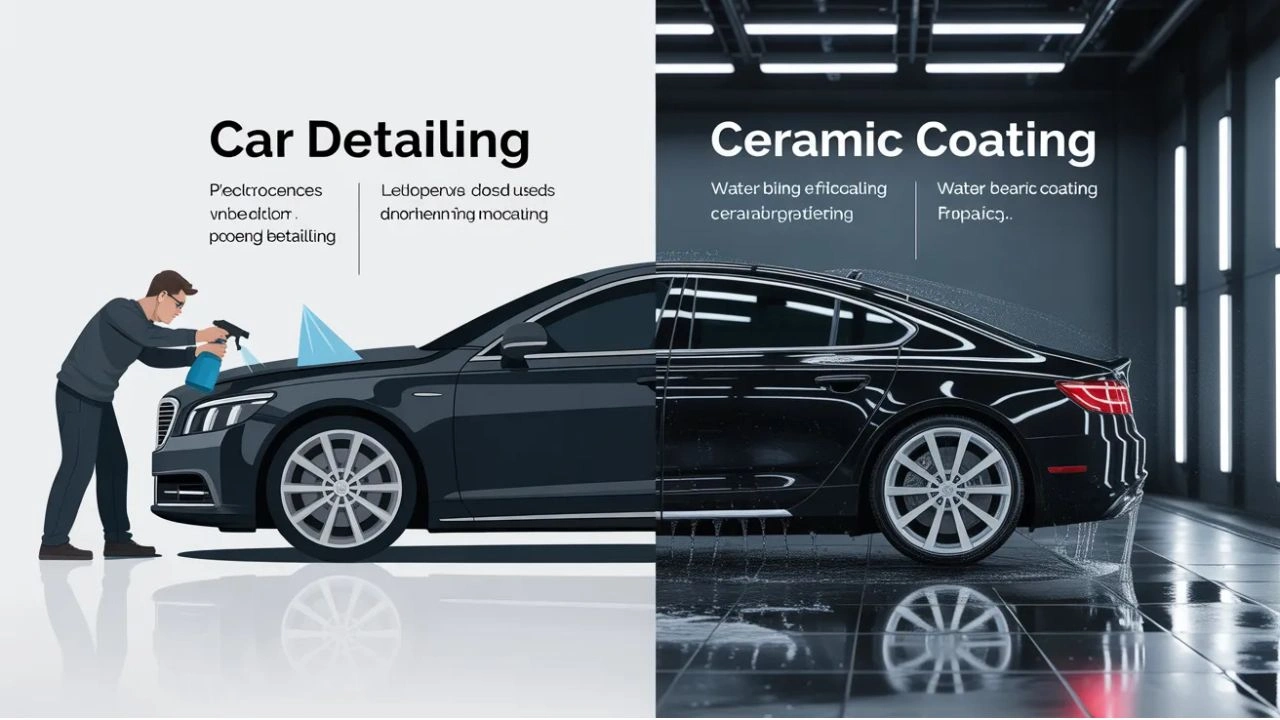
Car Detailing vs Ceramic Coating: If you care about your car’s appearance, longevity, and resale value, you’ve probably heard about car detailing and ceramic coating. Both promise a cleaner, shinier, better-protected vehicle. But they are not the same thing.
Many car owners assume ceramic coating is just “advanced detailing.” Others believe detailing alone is enough for long-term paint protection. The truth lies somewhere in between.
In this in-depth 2026 guide, we’ll break down:
- What car detailing really includes
- What ceramic coating actually does
- Cost differences
- Durability comparison
- Maintenance requirements
- Which option is better for your needs
By the end of this article, you’ll have a clear, practical understanding of which solution suits your vehicle, budget, and lifestyle.
What Is Car Detailing?
Car detailing is a deep cleaning and restoration process that enhances the appearance of both the interior and exterior of a vehicle.
Unlike a basic car wash, detailing focuses on thorough cleaning, correction, and cosmetic improvement.
Exterior Detailing Includes:
- Hand wash and foam pre-wash
- Clay bar treatment (removes bonded contaminants)
- Paint decontamination
- Polishing (removes swirl marks and light scratches)
- Wax or sealant application
- Tire and trim dressing
- Glass polishing
Interior Detailing Includes:
- Vacuuming carpets and seats
- Steam cleaning
- Leather conditioning
- Dashboard polishing
- Odor removal
- Fabric protection
The Main Goal of Detailing
The purpose of detailing is to restore shine, remove imperfections, and refresh the vehicle’s appearance.
It improves aesthetics dramatically — but the protection it provides is usually short-term.
What Is Ceramic Coating?
Ceramic coating is a liquid polymer applied to a vehicle’s exterior surfaces. Once cured, it chemically bonds with the paint, creating a durable protective layer.
Unlike wax, which sits on top of the paint, ceramic coating forms a semi-permanent bond.
What Ceramic Coating Does:
- Adds hydrophobic (water-repelling) properties
- Protects against UV damage
- Reduces oxidation
- Makes cleaning easier
- Adds deep gloss
- Protects from chemical stains
Ceramic coatings typically last 2 to 7 years, depending on product quality and maintenance.
The Key Difference: Cleaning vs Protection
Here is the simplest explanation:
- Car detailing = Cleaning and restoration
- Ceramic coating = Long-term protection
Detailing prepares the surface.
Ceramic coating protects the surface.
They are complementary, not identical.
Cost Comparison in 2026
Cost is often the biggest deciding factor.
Car Detailing Cost
- Basic detailing: $100 – $300
- Premium detailing with paint correction: $300 – $800
Detailing is more affordable upfront but may need to be repeated every 3–6 months.
Ceramic Coating Cost
- Entry-level coating: $600 – $1,200
- Professional multi-layer coating: $1,200 – $2,500+
The higher cost reflects preparation, paint correction, and product durability.
However, ceramic coating can last years instead of months.
Durability Comparison
Car Wax/Sealant (Applied During Detailing)
- Lasts 1–3 months
- Washes away gradually
- Needs regular reapplication
Ceramic Coating
- Lasts 2–7 years
- Chemically bonds to paint
- Resistant to washing and environmental damage
If longevity is your priority, ceramic coating clearly wins.
Paint Protection Capabilities
Car Detailing Protection Level
Detailing usually ends with wax or paint sealant.
Wax provides:
- Basic UV protection
- Temporary gloss
- Mild water repellency
But it does NOT protect against:
- Bird droppings for long periods
- Tree sap damage
- Hard water spots
- Chemical etching
Ceramic Coating Protection Level
Ceramic coating offers:
- Strong hydrophobic surface
- UV resistance
- Chemical resistance
- Better resistance to light scratches
- Reduced oxidation
Important note:
Ceramic coating is NOT scratch-proof. It is scratch-resistant.
Maintenance Requirements
After Car Detailing
You must:
- Reapply wax frequently
- Avoid harsh shampoos
- Maintain frequent washing
Without maintenance, shine fades quickly.
After Ceramic Coating
Maintenance is easier:
- Dirt washes off more easily
- Water beads instantly
- Less frequent waxing needed
- Requires pH-neutral shampoo
However, proper maintenance still matters. Neglect can reduce lifespan.
Shine and Gloss Comparison
Both options improve appearance, but differently.
Car Detailing Shine
Polishing during detailing removes swirl marks and oxidation.
This creates immediate clarity and gloss.
However, wax shine fades over time.
Ceramic Coating Shine
Ceramic coating enhances depth and gloss significantly.
It creates a “wet look” finish that lasts longer.
In terms of long-term gloss retention, ceramic coating performs better.
Scratch Resistance Reality Check
Many marketing claims exaggerate ceramic coating’s strength.
Car Detailing:
- Removes minor scratches
- Does not prevent new scratches
Ceramic Coating:
- Offers minor swirl resistance
- Reduces micro-marring
- Does NOT prevent deep scratches
If scratch protection is your main concern, consider paint protection film (PPF) instead.
Resale Value Impact
A well-maintained exterior increases resale value.
With Regular Detailing:
- Paint looks good temporarily
- Requires consistent upkeep
With Ceramic Coating:
- Paint condition preserved longer
- Less oxidation
- Better long-term appearance
Buyers often value ceramic-coated vehicles higher due to better paint condition.
Time Investment
Car Detailing:
Takes 3–6 hours depending on the package.
Ceramic Coating:
Requires:
- Paint correction
- Surface preparation
- Application
- Curing time
Total time: 1–3 days.
Ceramic coating is more labor-intensive.
Which Option Is Better for New Cars?
For new cars:
- Perform paint correction.
- Apply ceramic coating immediately.
This protects factory paint from day one.
Skipping coating may expose new paint to early oxidation and contamination.
Which Option Is Better for Older Cars?
For older cars:
1. If paint condition is poor:
- Detailing and paint correction first.
2. If paint is restored:
- Then apply ceramic coating.
3. If budget is limited:
- Regular detailing may be sufficient.
Climate Considerations
In harsh climates:
- Extreme sun exposure
- Acid rain
- Coastal salt air
- Dust storms
Ceramic coating offers better long-term protection.
In mild climates, regular detailing may be adequate.
DIY vs Professional Application
DIY Detailing:
Possible with proper tools.
DIY Ceramic Coating:
Risky without experience.
Improper ceramic application can cause:
- High spots
- Streaking
- Uneven curing
Professional installation is strongly recommended.
Long-Term Cost Comparison
Let’s compare 3 years:
Detailing every 4 months:
$400 average x 3 years = $1,200
Professional ceramic coating:
$1,500 one-time
The cost difference is smaller than expected over time.
Myths About Ceramic Coating
Myth 1: It makes the car scratch-proof.
False.
Myth 2: You never need to wash your car again.
False.
Myth 3: It replaces paint protection film.
False.
Ceramic coating enhances protection but is not invincible.
Ideal Buyer Profiles
Choose Car Detailing If:
- You prefer lower upfront cost
- You enjoy frequent maintenance
- You change cars often
- You want occasional shine boost
Choose Ceramic Coating If:
- You plan long-term ownership
- You want easier maintenance
- You park outdoors
- You want maximum gloss retention
Read Also: MG IM5 Set for 2028 Debut: A Futuristic Electric Sedan Aiming to Redefine Premium Mobility in India
Can You Combine Both?
Yes — and this is the best approach.
Professional ceramic coating requires paint correction, which is part of detailing.
So the ideal path is:
- Full detailing and paint correction
- Apply ceramic coating
- Maintain with periodic light detailing
They work together.
Final Verdict: Which Is Better?
There is no universal answer. It depends on your goals.
If you want:
Short-term shine at lower cost → Car detailing is enough.
Long-term protection and easier maintenance → Ceramic coating is better.
Best overall solution → Detailing + Ceramic coating combination.
Conclusion
Car detailing and ceramic coating serve different purposes.
Detailing restores beauty.
Ceramic coating preserves it.
In 2026, with rising car prices and increasing focus on resale value, protecting your vehicle’s paint is more important than ever.
If you see your car as a long-term asset, ceramic coating provides superior protection and cost efficiency over time.
If you view your car as temporary transportation, periodic detailing may be sufficient.
Ultimately, the better option is the one aligned with your ownership plans, climate conditions, and maintenance commitment.
Make your decision wisely — your car’s shine and value depend on it.