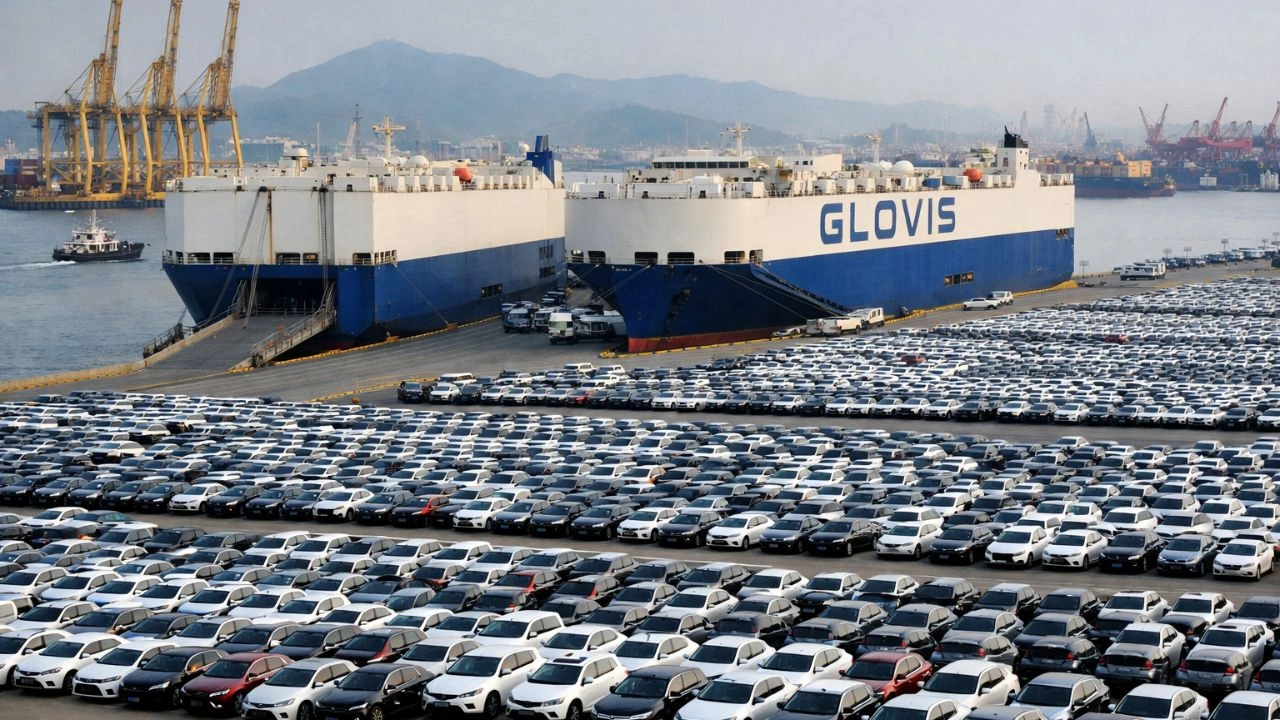
South Korea car exports decline: The global auto market just sent a warning signal—and South Korea felt it first, fast, and hard.
A dramatic export decline is exposing deep cracks in international demand, supply chains, and EV competition worldwide today.
South Korea’s automobile industry, long seen as a global export powerhouse, has hit a troubling milestone. In February, exports plunged by more than 20% year-on-year, raising serious questions about the health of the global automotive market and the future of export-driven economies.
This is not just a temporary dip—it’s a signal of shifting global dynamics, where demand, technology, and competition are rapidly evolving.
A Sudden 20% Drop: What Really Happened?
The numbers are stark.
In February, South Korea’s auto exports saw a double-digit contraction exceeding 20%, marking one of the sharpest declines in recent years. For a country where automobiles are a major economic pillar, this is more than just a statistical drop—it’s a strategic warning.
Why this matters:
- Automobiles are among South Korea’s top export sectors
- Millions of jobs depend directly or indirectly on this industry
- Export revenue plays a crucial role in national economic stability
What makes this decline even more concerning is its speed and scale. The drop wasn’t gradual—it was sudden, indicating a rapid shift in global market conditions.
Industry insiders point out that such a sharp fall often reflects multiple overlapping issues, rather than a single cause.
Read Also: BMW X3: The Perfect Balance of Luxury, Performance, and Intelligent Technology in a Premium SUV
Global Demand Is Cooling Faster Than Expected
One of the biggest drivers behind the slump is a noticeable slowdown in global demand.
Key markets are weakening:
- North America: High interest rates are reducing car affordability
- Europe: Economic uncertainty and energy costs are dampening consumer spending
- Emerging markets: Currency fluctuations and inflation are limiting imports
Consumers worldwide are becoming more cautious. Big-ticket purchases like cars are often the first to be delayed when economic uncertainty rises.
Expert Insight:
From a market strategist’s perspective, this trend reflects a post-pandemic correction phase. After years of pent-up demand and aggressive buying, the market is now stabilizing—but at a lower-than-expected level.
This is particularly challenging for export-heavy nations like South Korea, which depend on consistent global consumption.
Supply Chain Disruptions Still Haunt the Industry
Even in 2026, the auto industry hasn’t fully escaped supply chain chaos.
Persistent challenges include:
- Semiconductor shortages affecting vehicle production
- Shipping delays increasing delivery timelines
- Rising logistics costs squeezing profit margins
Although conditions have improved compared to peak crisis years, the system remains fragile.
A single disruption—whether geopolitical, environmental, or logistical—can ripple across the entire production chain.
Real-world impact:
Automakers are facing:
- Reduced production output
- Delayed exports
- Increased operational costs
This combination directly contributes to declining export volumes.
The EV Revolution Is Reshaping Competition
Perhaps the most significant shift is happening in the electric vehicle (EV) space.
South Korea has strong players in the EV segment—but the competition is intensifying rapidly.
The new competitive landscape:
- Chinese automakers are offering affordable EVs with advanced features
- Tesla and Western brands continue to dominate premium segments
- New startups are disrupting traditional pricing models
This has created a highly competitive global market where price, technology, and speed to market are everything.
Key challenge:
South Korean automakers must now balance:
- Innovation
- Cost efficiency
- Global scalability
Failing to do so risks losing market share in one of the fastest-growing automotive segments.
Impact on Automakers and Supply Chains
The export slump is already creating ripple effects across the industry.
Immediate consequences:
- Revenue pressures for major automakers
- Inventory buildup due to unsold vehicles
- Production adjustments to match lower demand
But the impact goes deeper.
Extended ecosystem affected:
- Auto component manufacturers
- Logistics and shipping companies
- Dealership networks worldwide
For many small and medium suppliers, even a slight reduction in orders can lead to serious financial strain.
First-hand industry perspective:
From a supply chain standpoint, such downturns often trigger cost-cutting measures, hiring freezes, or even restructuring. The effects are rarely isolated—they spread across the entire industrial ecosystem.
Government Steps In: Stabilizing the Industry
Recognizing the seriousness of the situation, policymakers are expected to act.
Potential measures include:
- Financial incentives for automakers
- Support for EV research and development
- Trade policy adjustments to boost exports
- Investment in supply chain resilience
Governments understand that the automotive sector is not just an industry—it’s a strategic economic engine.
Long-term focus:
There is a strong push toward:
- Green mobility
- Sustainable manufacturing
- Advanced automotive technologies
These initiatives aim to ensure that South Korea remains competitive in the next era of transportation.
The EV Transition: Risk or Opportunity?
While the current situation looks challenging, it also presents a massive opportunity.
The global shift toward electric vehicles is accelerating—and South Korea is well-positioned to benefit.
Strengths of South Korean automakers:
- Advanced battery technology
- Strong global brand presence
- Established manufacturing infrastructure
However, success will depend on speed and adaptability.
Strategic priorities:
- Expanding EV production capacity
- Reducing manufacturing costs
- Enhancing software and smart features
Those who adapt quickly will not just survive—they will lead.
What This Means for the Global Auto Industry
South Korea’s export decline is not an isolated event—it’s a global signal.
Broader implications:
- The auto market is entering a new phase of normalization
- Competition is becoming more intense than ever
- Innovation cycles are shortening rapidly
Countries and companies that fail to evolve risk being left behind.
Key takeaway:
The industry is shifting from:
Volume-driven growth → Value-driven innovation
What to Expect in the Coming Months
The road ahead is uncertain—but not without hope.
Possible recovery triggers:
- Stabilization of global economic conditions
- Improved supply chain efficiency
- Stronger demand for EVs
However, risks remain:
- Geopolitical tensions
- Inflationary pressures
- Rapid technological disruption
Expert outlook:
Most analysts expect a gradual recovery rather than a quick rebound. The next few months will be critical in determining whether this decline is temporary—or the start of a longer trend.
Read Also: Honda Zero SUV: Honda’s Revolutionary Leap Into the Future of Electric SUVs
Quick Snapshot: Key Takeaways
- Exports dropped over 20% in February
- Global demand slowdown is a major factor
- Supply chain issues still persist
- EV competition is intensifying rapidly
- Government intervention is likely
- Long-term outlook depends on innovation and adaptability
Final Insight: A Turning Point Moment
This is more than a temporary slowdown—it’s a turning point for South Korea’s auto industry.
The companies that:
- Embrace innovation
- Invest in EV technology
- Adapt to global shifts
…will define the next decade of automotive leadership.
Those that don’t may struggle to keep up in an industry that is evolving faster than ever before.