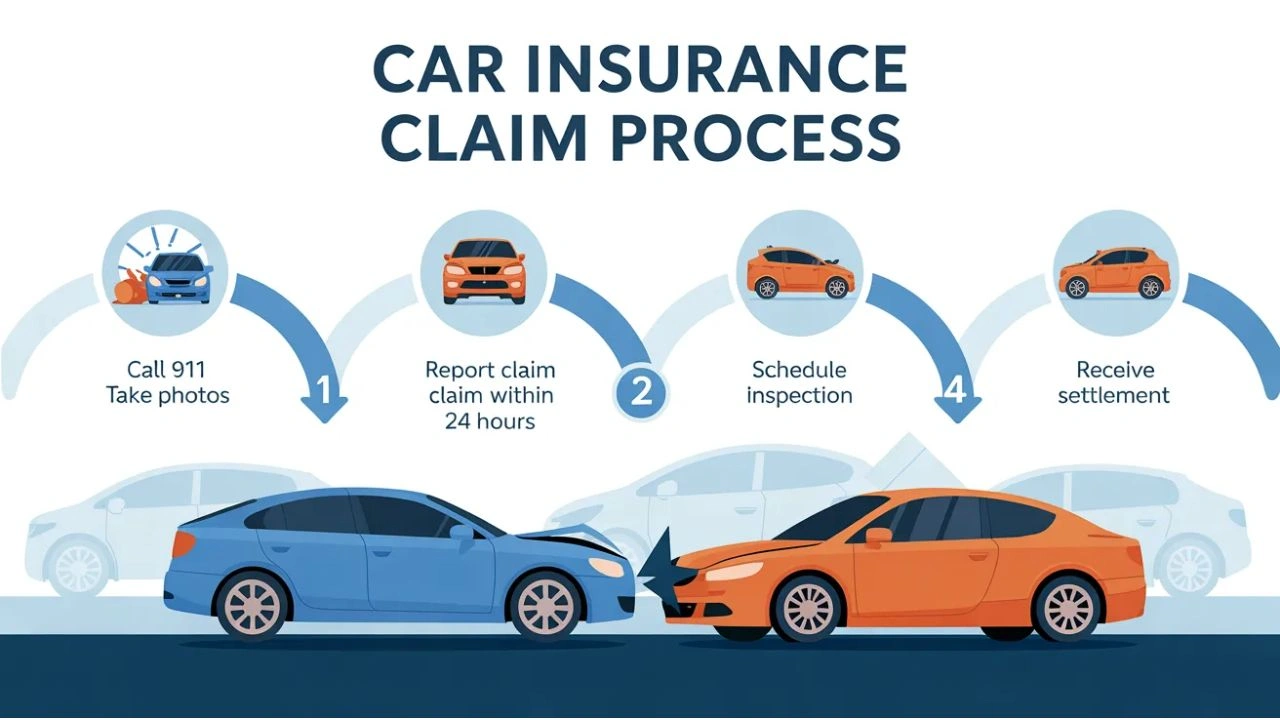
Car Insurance Claim Process After an Accident: A car accident can be overwhelming. Beyond the emotional stress and physical shock, there’s immediate confusion about what to do next — especially when it comes to insurance. Filing a car insurance claim the right way can mean the difference between quick compensation and frustrating delays, partial settlements, or outright rejection.
Understanding the car insurance claim process after an accident is essential for every vehicle owner. Whether the accident is minor or severe, your actions in the first 24 hours can significantly impact your claim outcome.
This comprehensive 2026 guide explains:
- What to do immediately after an accident
- How to file a car insurance claim
- Documents required
- Cashless vs reimbursement claims
- Claim settlement timeline
- Common mistakes that cause rejection
- How to maximize your compensation
Let’s walk through everything you need to know.
Step 1: Ensure Safety First
Before thinking about insurance, prioritize safety.
Immediately after an accident:
- Check yourself and passengers for injuries
- Move to a safe location if possible
- Turn on hazard lights
- Call emergency services if needed
Never leave the accident scene without proper documentation, unless safety demands it.
Step 2: Inform the Police (When Required)
Not all accidents legally require a police report, but many insurance companies recommend it.
You should file a police report if:
- There are injuries or fatalities
- Property damage is significant
- There’s a dispute about fault
- The other driver flees (hit-and-run)
- Drunk driving is suspected
A police report provides an official accident record, which strengthens your claim.
Step 3: Document Everything at the Scene
Documentation is crucial.
Take clear photos of:
- Vehicle damage (all angles)
- License plates
- Road conditions
- Traffic signals or signs
- Skid marks
- Injuries (if visible)
Also collect:
- Other driver’s name and contact
- Insurance company and policy number
- Vehicle registration details
- Witness contact information
The more evidence you gather, the smoother your claim process will be.
Step 4: Notify Your Insurance Company Immediately
Most insurers require you to inform them within 24–48 hours of the accident.
Provide:
- Date and time of accident
- Location
- Brief description of what happened
- Photos (if requested)
- Police report details (if filed)
Delaying notification can lead to claim rejection.
Even if you are not at fault, notify your insurer promptly.
Step 5: Understand the Type of Claim
There are typically two types of car insurance claims:
1. Cashless Claim
- Available at network garages
- Insurer directly settles the bill with garage
- You pay only deductible and non-covered items
2. Reimbursement Claim
- You pay repair cost upfront
- Submit bills to insurer
- Get reimbursed after approval
Cashless claims are generally faster and more convenient.
Step 6: Surveyor Inspection
After claim registration, the insurer assigns a surveyor.
The surveyor:
- Inspects vehicle damage
- Verifies accident details
- Assesses repair cost
- Approves repair estimate
Do not begin major repairs before surveyor approval unless emergency repair is required.
Unauthorized repairs may reduce claim eligibility.
Step 7: Vehicle Repair and Bill Processing
Once approved:
- The garage starts repairs.
- The insurer evaluates the final invoice.
- Deductibles are calculated.
- Depreciation adjustments may apply.
You must pay:
- Compulsory deductible
- Voluntary deductible (if chosen)
- Non-covered parts
- Depreciation cost (unless zero-dep policy)
Understanding your policy coverage is critical here.
Step 8: Claim Settlement
For cashless claims:
- The insurer pays the garage directly.
- You collect the vehicle after paying the balance.
For reimbursement claims:
- Submit original bills and documents.
- The insurer reviews paperwork.
- Settlement amount credited to your bank.
Typical settlement time: 7–30 days depending on complexity.
Documents Required for Car Insurance Claim
Be prepared with:
- Claim form
- Copy of insurance policy
- Vehicle registration certificate
- Driving license
- Police FIR (if applicable)
- Repair bills
- Payment receipts
- Photos of damage
Incomplete documentation causes delays.
Understanding Deductibles
A deductible is the amount you pay from your pocket before insurance covers the rest.
Two types:
Compulsory Deductible
Fixed amount defined by regulator or insurer.
Voluntary Deductible
Extra amount you choose to reduce premium.
Higher voluntary deductible = lower premium but higher out-of-pocket cost during claim.
What Is Depreciation in Insurance Claims?
Insurance does not pay full cost for certain parts due to depreciation.
For example:
- Plastic parts may receive lower claim percentage.
- Rubber components may have partial coverage.
- Metal parts depreciate based on vehicle age.
A Zero Depreciation (Zero-Dep) policy eliminates depreciation deduction.
If you have a zero-dep add-on, you receive higher claim payout.
Read Also: EV Battery Insurance Coverage: The Complete Guide for Electric Vehicle Owners
Third-Party vs Own Damage Claim
Own Damage Claim
Covers your vehicle damage.
Third-Party Claim
Covers damage caused to another person’s property or injury.
If the accident was your fault:
- Your insurer pays third-party damages.
- Your own damage coverage applies if included.
If other driver was at fault:
- Their insurer pays your damage (third-party liability).
Liability disputes may delay settlement.
Hit-and-Run Claim Process
In hit-and-run cases:
- File FIR immediately.
- Inform insurer.
- Claim through your own policy.
- Compensation may depend on policy terms.
Some countries have motor accident funds for hit-and-run victims.
Total Loss or Constructive Total Loss (CTL)
If repair cost exceeds:
- 75% of vehicle’s insured declared value (IDV)
It may be declared a total loss.
You receive IDV amount minus deductible.
Vehicle ownership may transfer to the insurer.
How No Claim Bonus (NCB) Is Affected
If you file an own-damage claim:
- You lose accumulated No Claim Bonus.
- Premium increases at renewal.
If you have NCB protection add-on, your bonus remains intact.
Sometimes small repairs may cost less than NCB loss — consider carefully before filing minor claims.
Common Reasons for Claim Rejection
Understanding these helps avoid mistakes.
Claims may be rejected if:
- Delay in reporting accident
- Driving under influence
- Invalid driving license
- Policy expired
- False information provided
- Unauthorized vehicle use
- Consequential damage
- Intentional damage
Honesty and prompt reporting are essential.
Timeline of Car Insurance Claim Process
Typical flow:
Day 1 – Accident occurs
Day 1–2 – Inform insurer
Day 2–3 – Surveyor inspection
Day 3–10 – Repair approval
Day 7–20 – Repairs completed
Day 10–30 – Claim settlement
Complex cases may take longer.
Digital Claim Process in 2026
Most insurers now offer:
- Mobile app claim filing
- Upload photos directly
- Instant survey approval for minor damage
- Real-time tracking
- Digital documentation
AI-based assessments speed up small claims significantly.
Tips to Maximize Your Claim Approval
- Inform insurer immediately
- Provide accurate details
- Submit clear photos
- Use network garages
- Keep all receipts
- Understand coverage limits
- Avoid exaggeration
- Maintain calm communication
Transparency builds trust with insurers.
What to Do If Claim Is Delayed or Rejected
If delayed:
- Contact customer support
- Escalate to grievance department
- Request written explanation
If rejected unfairly:
- Review policy terms
- Submit appeal
- Approach insurance ombudsman (if applicable)
Legal recourse is available in severe disputes.
Special Case: Accident Outside Home City
If accident occurs outside registered region:
- Inform the insurer immediately.
- Choose the nearest network garage.
- Provide towing receipts if covered.
Most comprehensive policies include nationwide coverage.
Should You Always File a Claim?
Not necessarily.
Consider:
- Repair cost vs NCB loss
- Deductible amount
- Impact on premium renewal
- Minor scratch repair cost
For minor dents under deductible value, it may be smarter to pay directly.
Emotional Mistakes to Avoid
After an accident:
- Do not argue aggressively.
- Do not admit fault immediately.
- Do not leave the scene without evidence.
- Do not repair before survey approval.
Calm, documented actions protect your rights.
Importance of Reviewing Your Policy Before an Accident
Many drivers read policy only after an accident.
Before any incident:
- Understand coverage limits
- Check add-ons
- Know deductible amount
- Verify emergency assistance numbers
Preparedness reduces panic.
Conclusion
The car insurance claim process after an accident may seem complex, but it becomes manageable with proper understanding.
The key principles are simple:
- Prioritize safety
- Document thoroughly
- Inform insurer quickly
- Follow procedure carefully
- Understand your policy
Insurance exists to protect you financially during unexpected events. However, it works best when you follow the process correctly.
In 2026, digital tools and streamlined systems have made claims faster than ever — but your cooperation and documentation remain essential.
A calm, informed approach ensures you receive fair compensation without unnecessary stress.
Drive safely — but stay prepared.
1 thought on “Car Insurance Claim Process After an Accident: Step-by-Step Guide”