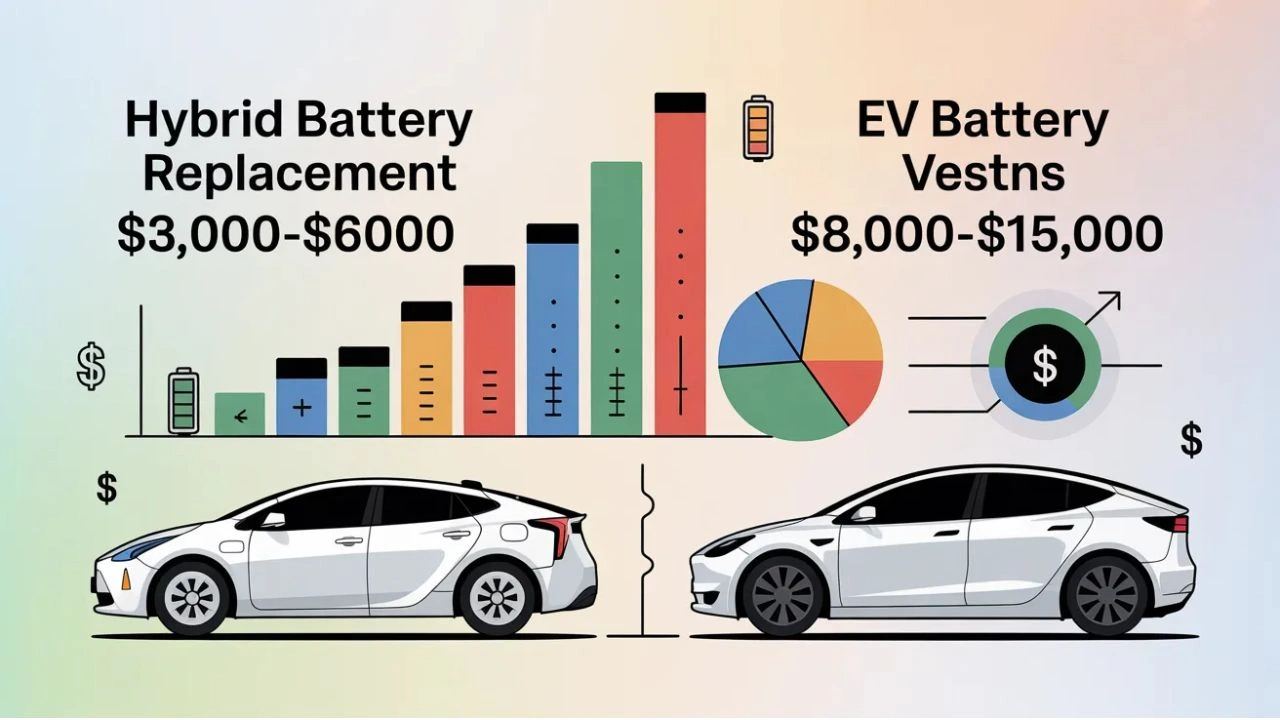
Hybrid And EV Battery Replacement Cost: The battery pack is the most critical and expensive component of any hybrid or electric vehicle. Unlike traditional internal combustion engine vehicles that rely on mechanical systems, EVs are fundamentally dependent on high-capacity lithium-ion battery systems.
Modern EVs predominantly use lithium-ion battery technology, known for high energy density, durability, and rechargeability. Hybrid vehicles, depending on generation and manufacturer, may use lithium-ion or nickel-metal hydride (NiMH) batteries.
Why Battery Replacement Matters
Battery degradation is natural over time. Factors influencing degradation include:
- Charging frequency and patterns
- Exposure to extreme temperatures
- Driving habits
- Depth of discharge cycles
- Battery management system efficiency
While most manufacturers design EV batteries to last 8 to 15 years, capacity gradually decreases. When usable capacity drops significantly—often below 70%—drivers may consider replacement.
However, replacement is rarely the first solution, as most batteries degrade slowly rather than fail abruptly.
How Much Does Hybrid Battery Replacement Cost in 2026?
Hybrid battery replacement costs vary significantly depending on vehicle type, brand, battery size, and whether the replacement is new, refurbished, or reconditioned.
Average Hybrid Battery Replacement Cost
In 2026, the typical price range is:
- $1,500 to $3,500 for refurbished or remanufactured hybrid batteries
- $3,000 to $8,000 for brand-new OEM battery packs
- Labor costs ranging between $500 and $1,500
Total Estimated Cost:
$2,000 to $9,000 depending on vehicle model and battery type
Smaller hybrid batteries are far less expensive than full EV battery packs because they operate alongside a gasoline engine and require lower capacity.
Refurbished vs New Hybrid Batteries
- Refurbished units are cheaper and often include warranties.
- New OEM batteries provide longer lifespan but at higher cost.
- Many hybrid owners opt for remanufactured batteries due to cost-efficiency.
The growing secondary market has significantly reduced hybrid battery replacement anxiety compared to a decade ago.
EV Battery Replacement Cost: A More Complex Equation
Electric vehicles, being fully battery-dependent, require larger battery packs—often ranging from 40 kWh to over 100 kWh.
Average EV Battery Replacement Cost in 2026
Current market estimates show:
- $7,000 to $20,000 for battery packs
- Labor between $1,000 and $3,000
Luxury EVs and long-range models may exceed $25,000 for full battery replacement.
However, it’s critical to note that battery prices per kWh have fallen dramatically over the last decade. According to industry analyses, average battery costs have dropped from over $1,100 per kWh in 2010 to below $150 per kWh in recent years.
This decline continues to make EV ownership more financially viable.
Read Also: Tata Avinya 2026: Expected Launch Date, Price, Range and Everything You Need to Know
Warranty Coverage: The Hidden Safety Net
One of the most overlooked aspects of battery replacement cost is warranty coverage.
Standard EV Battery Warranty
Most major automakers offer:
- 8 years or 100,000 miles minimum
- Some offer 8 years or 150,000 miles
- Coverage for defects and excessive degradation (often below 70% capacity)
This means that for most owners, battery replacement is covered under warranty if degradation exceeds manufacturer limits within that period.
In many markets, regulations require minimum battery warranties for EVs, adding an extra layer of consumer protection.
What Actually Causes Battery Failure?
Contrary to common fears, catastrophic battery failure is rare. Instead, gradual degradation is typical.
Key Causes of Battery Wear
- Repeated fast charging at high temperatures
- Continuous exposure to extreme heat
- Deep discharge cycles
- Manufacturing defects (rare but covered by warranty)
Modern battery management systems (BMS) actively monitor cell performance, balance charging, and prevent overheating, significantly extending lifespan.
Battery Degradation vs Replacement: When Is It Necessary?
Many EV owners assume range loss means replacement is inevitable. In reality:
- A 10–15% range loss over several years is normal.
- Most EV batteries retain 70–80% capacity even after 8–10 years.
- Replacement is typically needed only if performance becomes severely compromised.
In many cases, individual battery modules can be replaced rather than the entire pack, lowering repair costs significantly.
Global Trends Driving Battery Cost Reduction
Battery prices are not static. Several factors are pushing costs downward:
1. Mass Production
Gigafactories worldwide are scaling lithium-ion production.
2. Technological Advancements
Solid-state batteries and improved chemistry promise:
- Higher energy density
- Faster charging
- Longer lifespan
- Lower degradation rates
3. Recycling and Second-Life Applications
Battery recycling industries are growing rapidly. Extracting lithium, cobalt, and nickel from used batteries reduces raw material demand and cost.
Second-life usage in home energy storage further enhances value.
As recycling infrastructure improves, replacement costs are expected to decrease further by 2030.
Is Battery Replacement Worth It?
The economic decision depends on vehicle age and value.
For example:
- If a 10-year-old EV is worth $12,000 and battery replacement costs $15,000, replacement may not be financially sensible.
- If the vehicle retains strong resale value and battery pricing is reasonable, replacement may extend vehicle life by another decade.
Factors to Consider
- Vehicle resale value
- Warranty status
- Financing options
- Availability of refurbished packs
- Government incentives
In some regions, subsidies support battery replacement or refurbishment.
Comparing Hybrid vs EV Battery Replacement Cost
| Category | Hybrid | EV |
| Battery Size | Smaller | Large |
| Replacement Cost | $2,000–$9,000 | $8,000–$25,000 |
| Warranty | 8–10 years | 8+ years |
| Replacement Frequency | Rare | Rare |
| Refurb Options | Widely Available | Growing Market |
Hybrid batteries are significantly cheaper to replace, but full EV batteries are becoming more affordable over time.
The Myth of the “$30,000 Battery”
Early media coverage often exaggerated EV battery costs. While extreme cases exist—especially luxury models—most mainstream EV battery replacements fall well below headline-grabbing figures.
The key reality:
Battery replacement is expensive but increasingly rare within the first decade of ownership.
Insurance and Extended Warranty Options
Some EV owners choose:
- Extended manufacturer warranties
- Third-party battery insurance
- Leasing battery programs (in select markets)
Battery leasing models separate battery ownership from vehicle ownership, reducing upfront costs but adding monthly fees.
Environmental and Sustainability Implications
Replacing a battery instead of scrapping a vehicle supports sustainability goals. Battery recycling reduces mining demand and lowers environmental impact.
As global climate policies strengthen, battery lifecycle management becomes central to sustainable mobility.
Governments worldwide are investing in battery recycling ecosystems, further stabilizing long-term costs.
What Future Buyers Should Consider Before Purchasing
Before buying a hybrid or EV, consider:
- Battery warranty duration
- Battery health reports (for used vehicles)
- Availability of local service centers
- Estimated long-term depreciation
- Charging habits
Pre-owned EV buyers should request battery health diagnostics to assess degradation levels.
Read Also: Best Car Insurance Companies in 2026 – USA, Canada, India, and UK
2030 Outlook: Will Replacement Costs Disappear?
Industry analysts predict that by 2030:
- Battery cost per kWh may drop below $100
- Solid-state batteries may increase lifespan beyond 15 years
- Refurbishment markets will expand
- Recycling efficiency will improve
As a result, battery replacement cost anxiety is expected to diminish significantly.
Electric mobility is entering a mature phase, where long-term cost transparency is improving.
Final Analysis: Should Battery Replacement Fear Stop You?
The simple answer is no.
While hybrid and EV battery replacement cost remains a major financial consideration, the reality is more reassuring than alarming.
- Most batteries last 8–15 years.
- Warranty coverage protects early ownership.
- Costs are steadily declining.
- Refurbished markets offer alternatives.
- Technological innovation is accelerating.
Electric vehicles are no longer experimental—they are mainstream. As infrastructure, technology, and recycling ecosystems evolve, battery replacement becomes a manageable lifecycle event rather than a catastrophic expense.
For informed buyers, understanding battery economics transforms uncertainty into strategic decision-making.